
A pleasant church with an Altar-cloth, where Christ sits at the board,
And a shining candle shedding its ray on the white words of the Lord.
The Song of Manchan the Hermit, Anonymous, 9th century.
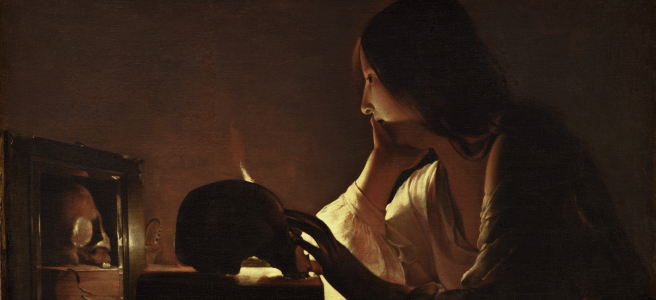
The Repentant Magdalene, c. 1630, Georges de La Tour
Whether in literature or painting, the soft flickering light of a candle brings an atmosphere of quiet reflection, but it can also illuminate a hidden interior world in conflict and plagued by haunting guilt.
In this painting, we see the seated St. Magdalene contemplating by soft candlelight the reflection of the skull that her fingers are subtly exploring. In both Renaissance and Baroque paintings, the presence of a skull is a trope that calls to mind the Latin phrase, memento mori, remember death. Here, the Magdalene is frozen in a moment of grim contemplation of her sinful past and a nascent hope that her repentance brings her a measure of spiritual expiation. For as St. Paul reminds us, “The sting of death is sin.” (1 Cor 15:56).
Notice the large book beneath the skull. Knowing that with de la Tour every object in a painting conveys a meaning, the book may well include Revelation 20:11-15, The Judgement of the Dead:
And I saw the dead, great and small, standing before the throne, and books were opened. Another book was opened, which is the book of life. The dead were judged according to what they had done as recorded in the books.
The painter uses chiaroscuro to draw our eye to her lit face and the reflected skull, which is shrouded in darkened hues. It is revealing that de la Tour does not have Magdalene gazing directly at the skull. The mirror creates a protective distance from the reminder of death, an attenuation of her guilt as she quietly repents. When we combine her fingers on the skull—a tactile, grim reminder, forcing her to confront her guilt—the message is unavoidable: our Lord is all-merciful, and when we turn away from sin and repent, we return to His good graces.
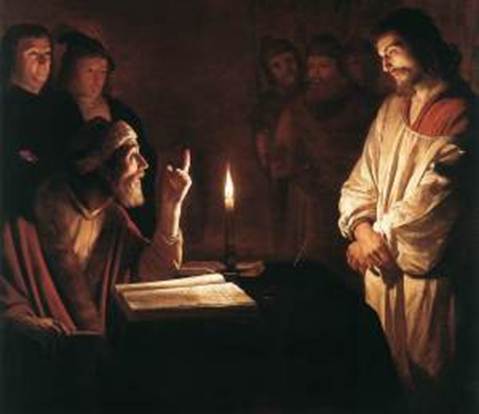
Christ Before the High Priest, Gerard van Honthorst, c. 1617.
We turn now to a painting that depicts a scene from the canonical Gospels when Jesus is questioned by Caiaphas, a high priest in the Jewish Sanhedrin who was responsible for plotting to kill Christ.
The scene takes place at night and is lit with a single candle, which casts an understated warmth on Jesus, whereas the light on Caiaphas shows us just enough of his face to reveal the portentous nature of the matter at hand. The high priest is seated at a table which separates him from Jesus and implicitly generates an antagonism between the physical world of Mosaic Law and the spiritual world of Christ’s divinity.
The differences in clothing convey another subtle but meaningful message. Christ is adorned in primarily white, the historical sign in Christianity of purity and innocence. Whereas Caiaphas is dressed in red, signifying blood and sacrifice.
In front of Caiaphas is a book of Mosaic Law, and his hand and finger are deliberately caught in the candlelight. He is pointing accusingly at Jesus, with a stern and harsh look. In contrast, the candle’s light graces Jesus’s face as he stands serenely looking down at Caiaphas, and his demeanor seems to spiritually set him apart from the serious, court-like proceeding.
In the background are other high priests who are appropriately shrouded in the diminished light of the candle. Two are closer, and in their darkened visages are the impassive looks of judges awaiting the decision. Others are standing further outside the illumination, their faces seemingly blank and staring.
With the scene set, we listen in hushed silence to Caiaphas’s interrogation of Jesus from Mark 14:60-65. Caiaphas demands…
“Are you the Christ, the Son of the Blessed?” And Jesus said, “I am; and you will see the Son of man sitting at the right hand of Power, and coming with the clouds of heaven.” And the high priest tore his mantle, and said, “Why do we still need witnesses? You have heard his blasphemy. What is your decision?” And they all condemned him as deserving death. And some began to spit on him, and to cover his face, and to strike him, saying to him, “Prophesy!” And the guards received him with blows.
It is a supreme irony that our Lord is condemned to death by the flickering flame of a candle, when, in truth, His blinding divine light is our only hope for salvation:
Again, Jesus spoke to them, saying, “I am the light of the world. Whoever follows me will not walk in darkness, but will have the light of life.” (John 8:12)
Philip E. Mella