
Music is an integral part of worship in most societies, and it was certainly a vital part of worship for the Israelites. History is replete with examples, from the mellifluous music of Gregorian Chant, and later, polyphony, to J.S. Bach’s The St. Matthew Passion. Music has graced the cathedrals of Europe for centuries and was the quintessential complement to liturgical services, illuminating the souls of worshipers.
We turn to the light of God, which penetrates the window to our soul, a metaphor that both William Blake and St. John of the Cross used with poignancy.
This life’s dim windows of the soul
Distorts the heavens from pole to pole
And leads you to believe a lie
When you see with, not through, the eye.
William Blake, The Everlasting Gospel, (c.1818)
The soul on which the divine light of God’s being is ever shining, or better, in which it is ever dwelling by nature, is like this window, as we have affirmed.
A soul makes room for God by wiping away all the smudges and smears of creatures.
St. John of the Cross (1542-1591),The Ascent of Mount Carmel, II.5.6–7, II.5.6–7
The ethereal light that is sent from heaven has lit the stained-glass windows in cathedrals across Britain and Europe, depicting biblical stories for the illiterate in medieval times. They have since become known as the Poor Man’s Bible, denoting their pedagogical role in lighting the path of the faithful over the centuries.
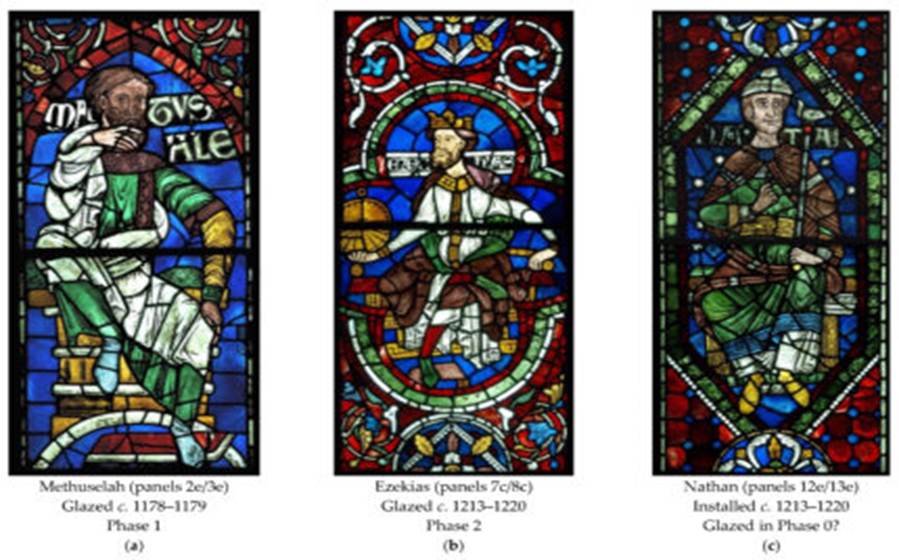
Below are three beautifully lit windows in Canterbury Cathedral, dating to the 12th and 13th centuries, from the Ancestors of Christ series, Methuselah, Ezekias and Nathan.
Music in Scripture often featured prophets with a variety of instruments, such as in 1 Sam. 10:5:
After that, you will go to Gibeah of God, where there is a Philistine outpost. As you approach the town, you will meet a procession of prophets coming down from the high place with lyres, timbrels, pipes and harps being played before them, and they will be prophesying.
St. Philip Neri (1515-1595) spontaneously sang the prayers of the last Mass that he celebrated, which reflects the timeless truth that all sacred music is but an exalted prayer, a profound expression of religious feeling, inviting us into a deeper contemplative meditation of our Lord.
The words of St. Paul in Ephesians 5:19, even if only taken in a spiritual sense, are meaningful signposts which highlight the elevated conception of music in the Old Testament:
Speaking to one another in psalms, and hymns, and spiritual canticles, singing and making melody in your hearts to the Lord.
St. Jerome (c. 342-420), in reference to this verse, provides a strong exhortation, underscoring the duty to sing in Church:
Let the servant of God sing in such a manner that the words of the text, rather than the voice of the singer, cause delight, and that Saul‘s evil spirit may depart from those who are under its dominion, and may not enter into those who make a theatre out of the house of the Lord.
The finest hymns we have create a perfectly dovetailed relationship between the words and music, and are enduring because they elicit some of the most profound spiritual sentiments in our souls. A poignant and euphonious example is Let All Mortal Flesh Keep Silence, an ancient chant of Eucharistic devotion which was composed in Greek in Anno Domini 275, as a Cherubic Hymn for the Offertory of the Divine Liturgy of St. James.
The lyrics are a powerful testimony to Jesus Christ and his gift to us through the Eucharist, in vanquishing the powers of hell and bringing eternal light to our souls. In those ancient days, communion was taken with extreme sincerity, for the people believed Christ’s body was truly present in the form of bread and wine. Therefore, spiritual preparation was critical before partaking, and this is where the hymn found its purpose.
In our age, the ubiquity of sounds—and their annoying cousins, noise—are symptoms of cultural overstimulation. Prime examples include the nearly incessant drone of the television, online movies, the interminable pings notifying us of new texts, and our Pavlovian response—the self-engineered need to read and respond immediately. In the first half of the 20th century, when our news source was newspapers, sounds were limited to the ring of the rotary telephone and radio, which meant there were far more moments filled with silence, which lured one into prayer. In his illuminating work titled Pensées (“Thoughts”), Blaise Pascal wrote:
All of humanity’s problems stem from man’s inability to sit quietly in a room alone.
There is far more than a grain of truth in that assertion, which is the ideal prologue to this hymn, one that provides a spiritually compelling reason to maintain a prayerful silence.
Delving into its history, English hymnologist J. R. Watson (b. 1934) notes:
In the original Liturgy of St. James, Let All Mortal Flesh Keep Silence was used as the bread and wine were brought into the sanctuary: it brings out the full drama of the occasion.
As we listen to this hymn, it seems to float in the sacred, rarefied air, its lilting tune and divine words are at once doleful and uplifting. The hymn was revitalized during the Oxford Movement of the 19th Century, when ancient Christian texts were translated from Greek and Latin into English. Watson, in his Annotated Anthology of Hymns (2002), p. 12, described the hymn this way:
The hymn is a sublime command, and the invocation of silence adds emphasis to the awe-inspiring greatness of God, which is signaled in this hymn. This is the opposite of those hymns which express the kindness and closeness of God (“What a friend we have in Jesus”): here God appears in majesty and light, accompanied by the glory of the heavenly host. The Eucharist is celebrated as an event in which this glory is given to the faithful.
The hymn is thus imbued with the mystery of Isaiah 6 and Revelation 4 and invites the singer to participate in the miracle of the Incarnation, a present sense of entering the Holy of Holies.
Another exquisite hymn is Be Still, My Soul, written by Catharina von Schlegel (1697-1777). What adorns this hymn with an alluring, mystical power is its haunting tune, which sheds the light of faith on souls struggling with pain, suffering, and even approaching death. The theme is drawn from Psalm 37, where David exhorts himself to “Be still before the LORD and wait patiently for him.”
Using the link above, you can listen to this mystical hymn, and as you do the words will appear, verse by verse. You will readily notice the scriptural motifs, from patience when we are afflicted (Romans 12:12), to the “waves and winds,” which refers to Mark 4:35-41. The final verse ends with,
Be still, my soul: when change and tears are past,
all safe and blessed, we shall meet at last.
The transition from the temporal world’s emotional toil and physical pain to the spiritual grace and mercy of heaven, when, we pray, we shall meet our Lord, is the ultimate blessing, a transition which we will all one day make.
The last hymn we will examine is How Great Thou Art, written by Swedish poet and minister Carl Boberg in 1885. Here is the author’s description of the hymn’s genesis, which is an exultant paraphrase of Psalm 8.
It was that time of year when everything seemed to be in its richest colouring; the birds were singing in trees and everywhere. It was very warm; a thunderstorm appeared on the horizon, and soon there was thunder and lightning. We had to hurry to shelter. But the storm was soon over, and the clear sky appeared. When I came home, I opened my window toward the sea. There evidently had been a funeral, and the bells were playing the tune of “When eternity’s clock calls my saved soul to its Sabbath rest”. That evening, I wrote the song.
It is one of the finest examples of the spiritually uplifting marriage of honeyed lyrics and evocative music, which effortlessly colludes to raise our souls in praise to our Almighty God. I can never sing the third verse without choking up:
And when I think, that God, His Son not sparing
Sent Him to die, I scarce can take it in,
That on the Cross, my burden gladly bearing,
He bled and died to take away my sin.
***** ***** *****
We finish with a poem I wrote on May 31, 2016, one year to the day following the tragic death of my brother, Bill, who died of a glioblastoma, that is, brain cancer. Bill had a Master’s degree in music and was a skilled musical composer, so my poem is a fitting tribute to him.
The Immortal Music
The sound of mortal music to the ear
Is captive to the clef and mode and scale,
An iridescent tune that always fails
To allay our deepest worries and our fears.
Familiar chords that echo in the mind
Are locked in memory until the day
They’re found in a sonata and then played,
And then the debt to art is paid in kind.
We think, mistakenly, that music ends
When we have shuffled off this mortal coil,
In truth, its dulcet sounds are like a foil,
Protection for the soul as it suspends
The spiritual interaction with that place,
The undiscovered country of our dreams,
The land that faith assures us is the scene
Where God exists outside of time and space.
Philip E. Mella
Beautiful, Phil. This provided some calm in the midst of a swirl of activity that is upon me. I forwarded this post to a dear friend and client of mine. Blessings, Robert
Thank you, Phil, for this deep and nourishing essay, that is filled with eternal truths. I was struck by the quote from Pascal, which reminded me that silence is a powerful aid in our search for God. To choose to sit in silence, when we could be doing so many other apparently important things, supports our desire to live according to God’s divine will. There is no higher purpose in life, nor speedier path to inner happiness, than to devote our lives to developing the inner silence that is the life of God.
You have touched on two of my favorite hymns, “Be Still my Soul” and “How Great Thou Art.” Both are riveting in their sublimeness. I was sorry to hear about you brother, even though it was 10 years ago for you – thanks for sharing that beautiful poem to his memory. Truly, the need to have silence and quiet for reflection is much needed in this world of bluster and chaos that seems to be escalating. And who better than to reflect on our Lord Jesus who is the same yesterday, today and tomorrow. He has seen it all and is not shaken by any of the events going on. “The Lord will keep in perfect peace the man whose mind is stayed on Thee, because he trusteth in Thee.” Isaish 26:3. Jeff
Mella children, thanks to our mother who excelled at the piano and was professionally trained in opera, grew up in a home where music often filled the rooms. Her lyric soprano voice with a light, clear timber and fingers that danced across the piano keys was mesmerizing; it taught us to sit quietly and listen. Yes, on many occasions, we gathered around the piano and sang along with her! Our mother did so much more than bring music to our ears; she helped us cultivate a mode of perception. This led us to understand the importance of closing our eyes and letting our inner souls speak. What magic lit up my imagination when I, as a child, would watch the late evening clouds skate by out my bedroom window! On occasion we should all follow W. H. Auden’s advice: “Stop all the clocks, cut off the telephone” create silence, impose stillness, and something essential may enter.