
Philip E. Mella
Shakespeare’s Sonnet 65
Since brass, nor stone, nor earth, nor boundless sea
But sad mortality o’er-sways their power,
How with this rage shall beauty hold a plea,
Whose action is no stronger than a flower?
O, how shall summer’s honey breath hold out
Against the wrackful siege of batt’ring days,
When rocks impregnable are not so stout,
Nor gates of steel so strong, but time decays?
O fearful meditation! where, alack,
Shall time’s best jewel from time’s chest lie hid?
Or what strong hand can hold his swift foot back?
Or who his spoil of beauty can forbid?
O, none, unless this miracle have might,
That in black ink my love may still shine bright.
In this sonnet, Shakespeare poses a question that has vexed poets for centuries: how can beauty survive in our harsh and unforgiving world, where the ravages of time indiscriminately draw the lifeblood from every object.
His conclusion, captured in the final couplet, is what we might expect in our circumscribed landscape: through the written word, the artist perpetually abridges time, thus protecting his “spoil of beauty.” The same aesthetic mode is in play in Renaissance sculptures and paintings, which marvel our senses and delight our imaginations.
Despite the obvious value of beauty in all its forms, we might ask whether it suffers what amounts to a perpetual aesthetic half-life. To wit, due to the vicissitudes of culture and aesthetic beliefs, and the diminishing returns of education, has our understanding of the Greek tragedians or the works of Renaissance artists become attenuated? We know that the classic liberal education, the core of the Western canon, has been grossly stigmatized by the post-modernists. Politics aside, when seminal artistic works are unwisely discredited the horizon of our understanding of human nature is commensurately abbreviated.
That aside, as we plumb the nature of beauty, we are obliged to ask if it remits any enduring value or vicarious utility during acutely difficult times, for instance, in sickness, and, in particular, as we approach our death. Or is that a misplaced request, a misunderstanding of beauty’s nature?
In light of its myriad forms, a case can be made that beauty is, in fact, perfectly suited to provide timely and meaningful counsel and insights, which can lead to discovering untapped inner resources to sustain us. However, without the complementary spiritual dimension, its power succumbs to a form of aesthetic entropy.
For a compelling example, let’s examine Michelangelo’s Pieta (Madonna della Pieta, Our Lady of Pity).
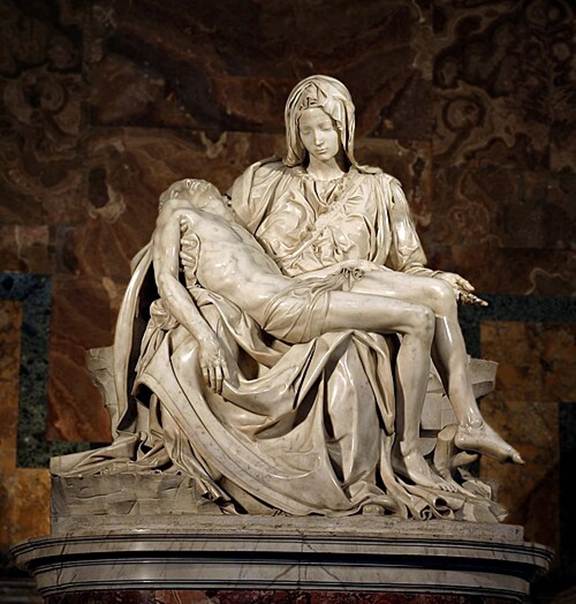
The Pieta captures the Virgin Mary’s sixth sorrow, receiving the body of her bloodied, scourged son, Jesus. We become witnesses to Mary’s hushed agony, with the echo of Jesus’s final words, “Woman, behold your son!” (John 19:26), ringing in our ears.
When we participate in others’ sufferings, we willingly become vulnerable to the panoply of emotions that befall them. We can contemplate Mary’s stunned silence as she feels the weight of her son’s lifeless body, and His expressionless face that suffered so grievously on our behalf.
We deepen the spiritual dimension when we prayerfully gaze through our mortal haze into the spiritual realm, recognizing that the moment Michelangelo captured in marble is, to our astonishment, always present. Indeed, the veil of time duplicitously convinces us that the metronomic moments that haunt our consciousness mark the limits of our human understanding.
To cross the spiritual threshold we should begin by silencing that interior voice which so effectively anesthetizes our fledgling efforts to take the first step. When we begin to breathe the rarefied air in that other world, we clearly see that artistic creations are infused with a spiritual beauty, which transforms our aesthetic understanding, creating an additional dimension grounded in the glory of God.
Ensconced in this realm, we can contemplate the Pieta with new eyes, paradoxically drawing from its profound sorrow a spiritual strength that can overpower our own grief and suffering. For now, we look “…not on what is seen, but on what is unseen, since what is seen is temporary, but what is unseen is eternal.” (2 Corinthians 4:18)